How AI Is Decoding Whale Communication, and What It Teaches Companies About Their Own Data
AI has not decoded what whales say. What it has shown is that scientists spent years setting part of the language aside as noise, because it did not fit their categories. Companies do the same every time they clean their data, and what they set aside is often the most important thing their customers are telling them.
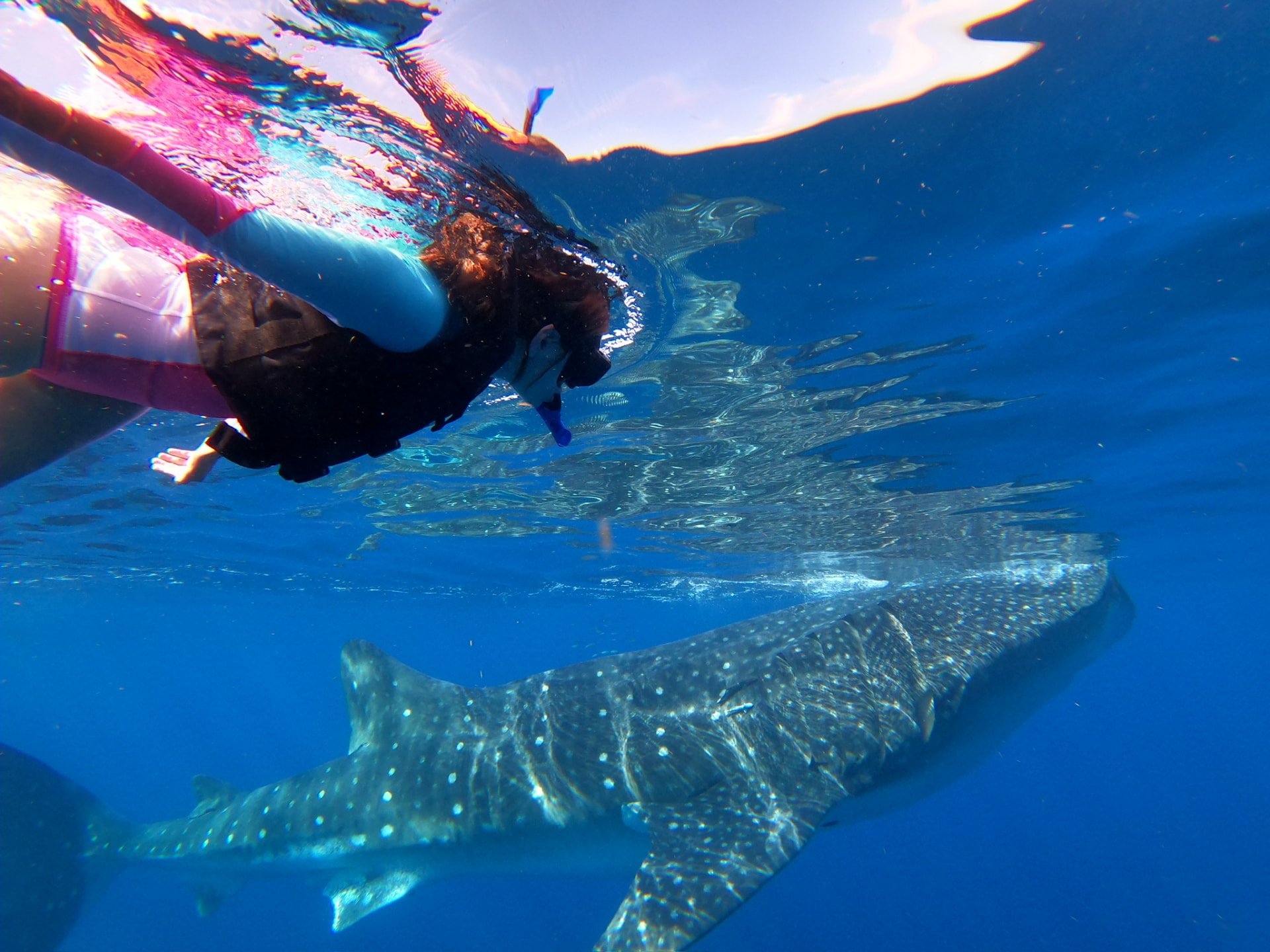
Off Holbox, a small island at the northern tip of Mexico's Yucatán peninsula, my son Elliot and I have twice slipped into the water next to an enormous animal with a dark back covered in pale spots. Elliot is obsessed with the ocean and wants to be a marine biologist, so for him these trips are not holiday activities. They are the closest thing he has to fieldwork.
The animal is called a whale shark, but it is not a whale. It is a shark, the largest fish in the sea, named after an animal it is not related to because the people who named it sorted the ocean by what they could see. It was as big as a whale, so they called it one.
I have been fascinated for as long as I can remember by the fact that whales talk to each other. We have watched humpbacks together, and we are planning a whale-watching holiday for Christmas to Cabo San Lucas. On trips like these, the guide often lowers a hydrophone, an underwater microphone, over the side of the boat, and everyone goes quiet. You hear moans, clicks and long rising calls, and you are completely certain that something is being said. You just have no idea what.
A while ago Elliot told me that researchers are now trying to decode what whales say with AI. My reaction was the one I have whenever someone tells me AI is about to solve something: wait, what? So I went to find out where the research actually is. The answer surprised me. Researchers have mapped a lot of the structure of how whales communicate, but nobody can translate what they are saying to each other. What they also found is that they had been leaving part of the language out of their analysis, because it looked like mess in the data. Every company I have worked with does the same thing with its own data.
We have learned a lot from animals, but only by watching what they do
When I started teaching at Singularity University, the idea everyone was fascinated by was swarm intelligence. Ants, bees, birds and fish solve problems that no single animal in the group could solve, without a leader and without a plan. An ant colony finds the shortest route to food because every ant leaves a scent trail and the shorter trails get reinforced faster. In the 1990s, Hewlett-Packard routed telephone calls with software modeled on ant trails, an idea popularized as swarm intelligence. The same idea now sits behind research on drone swarms that a single person can control.
All of that came from watching animals from the outside. We copied what they do, and we never needed to know what an ant was thinking, because as far as anyone can tell a single ant is not thinking much at all. Whales are a different case. They are not a swarm of simple units following rules. They are large-brained animals that live in families, learn from each other and talk, which means the most interesting thing about them is not what they do but what they say.
Whales changed how they talk within a few decades when we made the ocean noisy
The fact that convinced me there really is something to decode is not a song. It is how whales reacted to us. In the second half of the twentieth century the oceans filled with ship engines, and ship noise sits in the same low range as many whale calls. North Atlantic right whales responded by changing their pitch. When the biologist Susan Parks compared recordings from 1956 with recordings made between 2000 and 2004, the calls had moved about two-thirds of an octave higher, above the worst of the engine noise. Killer whales in the waters between Washington State and Vancouver Island, followed by as many as 22 whale-watching boats a day, started making calls about 15 percent longer when boats were around, a change that did not appear in recordings made 15 and 25 years earlier.
Right whales moved their calls up, out of the range of ship noise
How to read it. North Atlantic right whales greet each other with a short call that rises in pitch. Higher up the scale means a higher pitch, and each line up doubles the frequency. The shaded band is where the noise of ship engines is loudest. Susan Parks compared recordings from 1956 with recordings made between 2000 and 2004 and found the calls had moved up by about two-thirds of an octave, most of the way out of that band. The shape of the call is drawn for illustration; the size of the shift is the study's.
Source: Parks, Clark and Tyack, Journal of the Acoustical Society of America (2007), via Penn State.
This was not evolution, which would take thousands of years. It happened within a few decades, which means the whales noticed that their messages were not getting through and changed how they sent them. That is what you would expect from animals that have something worth saying, and it is why so many people, my son among them, want to know what it is.
For decades, scientists sorted whale clicks into types and called everything else variation
Sperm whales are the largest animals on Earth with teeth, and they have the largest brain of any animal that has ever lived. They do not sing like humpbacks. They talk in clicks. When a group of them meets near the surface, they exchange short bursts of clicks called codas, a little like someone tapping out a rhythm on a table, and the others answer with rhythms of their own.
Off the island of Dominica in the Caribbean, scientists have been recording these exchanges for twenty years. To make sense of them, they did what any sensible researcher would do. They counted the clicks in each coda and measured the gaps between them, and sorted the codas into types. Around 150 coda types have been identified worldwide, and 21 of them among the families off Dominica. A coda with five evenly spaced clicks was one type, a coda with three slow clicks and two fast ones was another.
The codas never matched their types exactly. Some were a little longer, some a little faster, some had something extra. The research literature had a name for all of that: "unexplained 'within-type variation'." It was treated the way you treat the hiss on an old recording, as noise around the signal. As Gašper Beguš, a linguist at the University of California, Berkeley, put it, "In the past, researchers thought of whale communication as a kind of morse code." In Morse code, only the pattern of short and long matters. Whether the person sending it taps a little faster or a little slower makes no difference to the message. So once researchers thought of the clicks as a kind of Morse code, they measured the pattern and treated small differences in speed or sound as sloppiness, not as part of the message. The comparison worked like the name whale shark: once it stuck, it decided what people looked at.
The scientists measured the pattern and set the differences aside
How to read it. A sperm whale talks in codas, short bursts of clicks. Researchers sorted each coda into a type by counting its clicks and measuring the gaps, here five evenly spaced clicks, drawn as black ticks. The real clicks never sit exactly on the type. The orange marks show how far each one is off. For decades that difference had a name, within-type variation, and it was treated as noise. The spacing here is drawn for illustration.
Source: Sharma et al., Nature Communications (2024); Beguš et al. (2025).
Nobody made a mistake. The types were a reasonable way to start, and they made decades of research possible. But the moment you decide what a coda is, you have also decided what it is not, and everything in the second pile stops being studied.
The language was in the pile marked variation
In 2020, a nonprofit called Project CETI, the Cetacean Translation Initiative, set out to apply machine learning to the Dominica recordings. In 2024 its researchers published an analysis of 8,719 codas recorded between 2005 and 2018. Instead of asking which type each coda belonged to, they looked at how the codas changed from one to the next within a conversation.
Two things came out of the variation. The first they called rubato, after the musical term for stretching and compressing time. Over the course of an exchange, the whales slowly lengthen or shorten their codas, and the whale answering follows the change, the way two musicians slow down together without anyone counting out loud. The second they called ornamentation: an extra click at the end of a coda that is otherwise identical to its neighbors, which shows up in about 4 percent of codas. Neither had been described before. Together they could roughly double the amount of information a single coda carries.
The next discovery came from listening to the clicks themselves. Gašper Beguš trained an AI model to imitate codas without giving it any labels at all, so it had no idea what the scientists considered important. The model started treating the sound of each click, not just its timing, as meaningful. When the team went back to the recordings, removed the timing and listened to each click as a sound in its own right, they found two distinct types, which they compared to the vowels "a" and "i", and clicks that glide from one to the other within a single coda, the way the vowels in "buy" or "boy" glide. That study was published in November 2025. One report described the AI not as a translator but as a hypothesis engine.
The model did not find any of this because it knew more than the scientists. It found it because it knew less. It had never been taught that codas were Morse code, so it had nothing telling it which part of the sound to ignore.
Three things came out of the pile marked variation
How to read it. Each panel is one finding that came out of what had been filed as within-type variation. The first two came from a 2024 analysis of 8,719 codas recorded off Dominica. The third came in 2025, after an AI model trained without any labels started treating the sound of each click as meaningful. Together they could roughly double the information a single coda carries. Nobody yet knows what any of them means. The drawings are illustrations, not measurements.
Sources: Sharma et al., Nature Communications (2024); Beguš et al., Open Mind (2025).
Researchers found the structure in humpback song by listening the way a baby does
The humpbacks I saw off Peru are the singers. Males sing long, repeating songs that can last for hours, and the song changes over time and spreads from one population to another, so that whales thousands of kilometers apart end up singing the same new version. For half a century people have recorded these songs and described their themes and phrases. What nobody could say was where one unit of the song ended and the next began, because nobody knew what a unit was.
In February 2025, a team of researchers published a study in Science based on eight years of humpback recordings from New Caledonia, in the South Pacific. They solved the problem by borrowing a method from how babies learn to talk. A baby does not know what a word is before it finds one. It notices that sounds inside a word tend to follow each other predictably, while the sound after a word is harder to predict, and it learns to put the boundaries where the surprise is. The researchers did the same with the whale song, letting the surprises mark the boundaries instead of deciding the units in advance.
The units they found followed Zipf's law, a pattern found across human languages: the most common word is used about twice as often as the second most common, three times as often as the third, and so on. The authors think the reason is that both human language and whale song are learned from others, and structures that make learning easier tend to survive.
Both teams got further by assuming less. It is an uncomfortable idea for anyone whose job is to be the expert in the room: the method that worked best was the one that started out knowing least.
Where the research is: AI can predict what whales will do, but nobody knows what they said
Sperm whales feed by diving to around 700 meters for 45 minutes to an hour, hunting squid in complete darkness, then come back up to breathe. In October 2026, Giovanni Petri, one of Project CETI's lead researchers, described how the team now pairs its recordings with tags that log each whale's depth, movement and heart rate. Their models can tell from around eight to ten codas whether the whales are about to start a deep foraging dive.
The researchers can predict what the whales are about to do from what they are saying, and they still cannot translate what the whales said. They have a working signal without a dictionary.
The moments that matter most are the hardest to read. In July 2023, off Dominica, the team filmed a sperm whale giving birth. Females from two families that are not related to each other gathered around the mother and took turns holding the newborn up to the surface so it could breathe. Their study of the birth came out in March 2026, alongside a second paper in Science. Based on more than six hours of underwater audio and drone footage, the researchers found that the whales switched to slower, longer codas at the key moments of the birth, including the vowel-like sounds described above. Something was clearly being said. Petri's comment on events like this is that they "probe the limits of what we can ever hope to translate."
Humpbacks have even answered back. In 2021, off Alaska, researchers from the SETI Institute, the University of California, Davis and the Alaska Whale Foundation played a recorded humpback contact call into the water from their boat. A whale they know as Twain approached, circled the boat and answered each call, matching the gaps between them, for about 20 minutes. The lead author, Brenda McCowan, called it what the team believes is "the first such communicative exchange between humans and humpback whales." Nobody knows what either side said.
So this is where the research stands as of November 2026. Scientists can describe the building blocks of sperm whale codas, find word-like units in humpback song, predict a dive from a handful of clicks and keep a humpback in an exchange for twenty minutes with a recording. Google has trained a model on four decades of dolphin recordings that runs on a phone in the field. A few things have a known function: some codas work like a badge, marking which clan a whale belongs to. What nobody has is a translation of a single conversation.
Calling the clicks vowels is still a human guess, and that is the honest result
The strongest objection to all of this is that the words are doing too much work. "Alphabet", "vowels" and "conversation" are human ideas laid over animal sounds. A click whose sound resembles an "a" is not a vowel in any sense a linguist would defend, and a rhythm that predicts a dive may be no more a sentence than a dog's bark before a walk. Morse code was a human comparison too, and it is the one that kept the variation in the second pile for so long.
That objection is right. AI has found structure in whale communication. It has not found meaning. Every time the structure is described to the rest of us, people who speak human languages choose the words, and those words will shape what the next researcher goes looking for. Whoever builds the first whale dictionary will also decide what counts as a word.
What the objection cannot take away is the part that does not depend on any of those words. The slow changes in tempo, the extra clicks and the two kinds of click sound can be measured, and they sat in the recordings for years before anyone measured them. A machine caught what we had missed because whales do not sound like us.
Every company cleans its own whale language out of its data
Every data team has a step called cleaning. Before anyone analyzes anything, the messy records are removed or forced into shape: the outliers, the comments that do not fit a field, the calls logged as "other", the customers who do not fit any segment. Most of the time that is sensible, because nobody can analyze a mess. It is also exactly what happened to the whales' within-type variation. The part of the data that does not fit the categories gets called dirty, and the cleaning removes it before anyone has asked whether it was the most interesting part.
Swarm intelligence taught companies to copy what animals do. The whale research teaches something different, because nobody is going to copy a coda. What we can copy is the way the scientists finally heard it. Every organization has its own 21 coda types. When a customer cancels, someone picks a reason from a drop-down list: too expensive, missing a feature, moved to a competitor. When a sales rep finishes a call, they fill in five fields in the CRM. Those lists were written by people who already knew what they expected to hear, and everything that does not fit ends up in "other", in a free-text box nobody reads, or in a recording nobody plays back. That is the company's within-type variation.
The pattern a company misses often sits in the box marked "other"
How to read it. This is an illustration, not data. Each dot is a customer who cancelled. First they are sorted the usual way, by the reason someone picked from a drop-down list, and the "other" row, in orange, is what a data team usually removes before analysis. Then the same customers are grouped by a model by how similar their actual comments and calls are, before anyone names the groups. Two groups look roughly like the old reasons. The third, in pink, pulls customers from every reason, most of them from "other". That is the group worth a closer look.
This goes further than lost information. The categories a company writes down decide what the business is allowed to know. The segments in the market model decide which customers anyone thinks about. The reasons in the churn field decide which problems get a budget. The labels on customer requests decide which ones become features on the product roadmap. And when the company trains or prompts an AI system on that data, it hands the same categories to the machine, which then reports back the world it was taught to see.
The method does not transfer as easily as it sounds, and the reason is the most useful part of the lesson. Beguš's model had only ever heard whales. A company that pastes its support transcripts into ChatGPT or Claude is using a model that has read almost everything people have written about why customers leave, so it arrives with the drop-down list already in its head. Ask it why your customers cancel, and it will hand you a tidy version of the categories you already have. To get what the whale researchers got, the order of the work matters. First let a model sort the raw material, the call recordings, the support transcripts and the free-text fields, into groups by how similar they are, without asking it to name anything. Only then look at the groups, name them yourself and compare them with your categories. The places where its groups cut across yours are where your categories are hiding something. Then do what Project CETI does, and treat every pattern as a hypothesis to test with real customers before anyone presents it to the board.
The dive prediction carries a second lesson. A company can often act on a signal before it understands it, the way the researchers know a dive is coming without knowing what was said. That is useful as long as everyone remembers which of the two they have. A pattern that predicts what customers will do is not an explanation of why they do it, and the board that confuses the two will eventually be surprised by its own data.
The last time we really listened to whales, it changed how the world treated them
This has happened once before. In the late 1950s, a US Navy engineer named Frank Watlington was manning a secret hydrophone station off Bermuda, listening for Soviet submarines. He kept picking up long moaning and wailing sounds that were not what he was listening for. He kept the tapes anyway, and in 1966 he gave copies to Roger Payne, a young biologist, who heard something else entirely: songs. In 1970, Capitol Records released them as Songs of the Humpback Whale, which is still the best-selling nature recording of all time. It helped start the worldwide Save the Whales movement, one of several forces behind the International Whaling Commission's vote in 1982 to pause commercial whaling, a ban that took effect in 1986. A few countries still hunt whales today.
Watlington and Payne were listening to the same recordings. What changed was what each of them thought he was hearing. The moment whales stopped being noise and became singers, the world changed what it did to them.
When we go whale watching in Cabo San Lucas this Christmas, the guide will probably lower a hydrophone over the side again, and we will all go quiet to listen. I used to think of those sounds as a message we could not read. Now I think of them more like the box marked "other": full of things nobody has looked at properly, because we had already decided what we were listening for. Elliot will grow up in a field where the machines are often better than the people at hearing what does not fit. The first time we really listened to whales, it helped turn most of the world against hunting them. This time the test is whether we can listen without deciding in advance what we are going to hear.
Sources
- Sharma et al., Nature Communications, 2024: Contextual and combinatorial structure in sperm whale vocalisations
- ScienceBlog, November 2025: Sperm whales may be speaking in vowels too (Beguš et al., Open Mind)
- Australian Geographic, February 2025: Whale song patterns follow a universal law of human language (Arnon, Garland, Kirby et al., Science)
- Northeastern Global News, October 22, 2026: How to speak whale
- Harvard SEAS, March 2026: Studies documenting rare sperm whale birth and ancient cooperative care released
- UC Davis, December 2023: Whale-SETI: humpback whale encounter reveals potential for non-human intelligence communication
- Maginative, April 2025: With DolphinGemma, Google is trying to decode dolphin language using AI
- Penn State, 2008: Right whales may be adapting to ocean noise pollution (Parks, Clark and Tyack, 2007)
- Scientific American, 2004: Tourist boats force killer whales to shout above the din (Foote et al., Nature)
- The Conversation: How swarming animals can help humans and AI make better decisions
- Summary of Bonabeau and Meyer, Harvard Business Review, 2001: Swarm intelligence
- Wikipedia: Songs of the Humpback Whale (album)
- NPR, December 2014: The songs that saved the whales
- Nature Asia, March 2026: Sperm whale birth press release (Scientific Reports)
- Max Planck Institute for Psycholinguistics, 2022: Whale clans use vocalisations to mark their culture (Hersh et al., PNAS)